A Childhood Armament Program
In millions of comic books, ads make all kinds of weapons attractive to children.

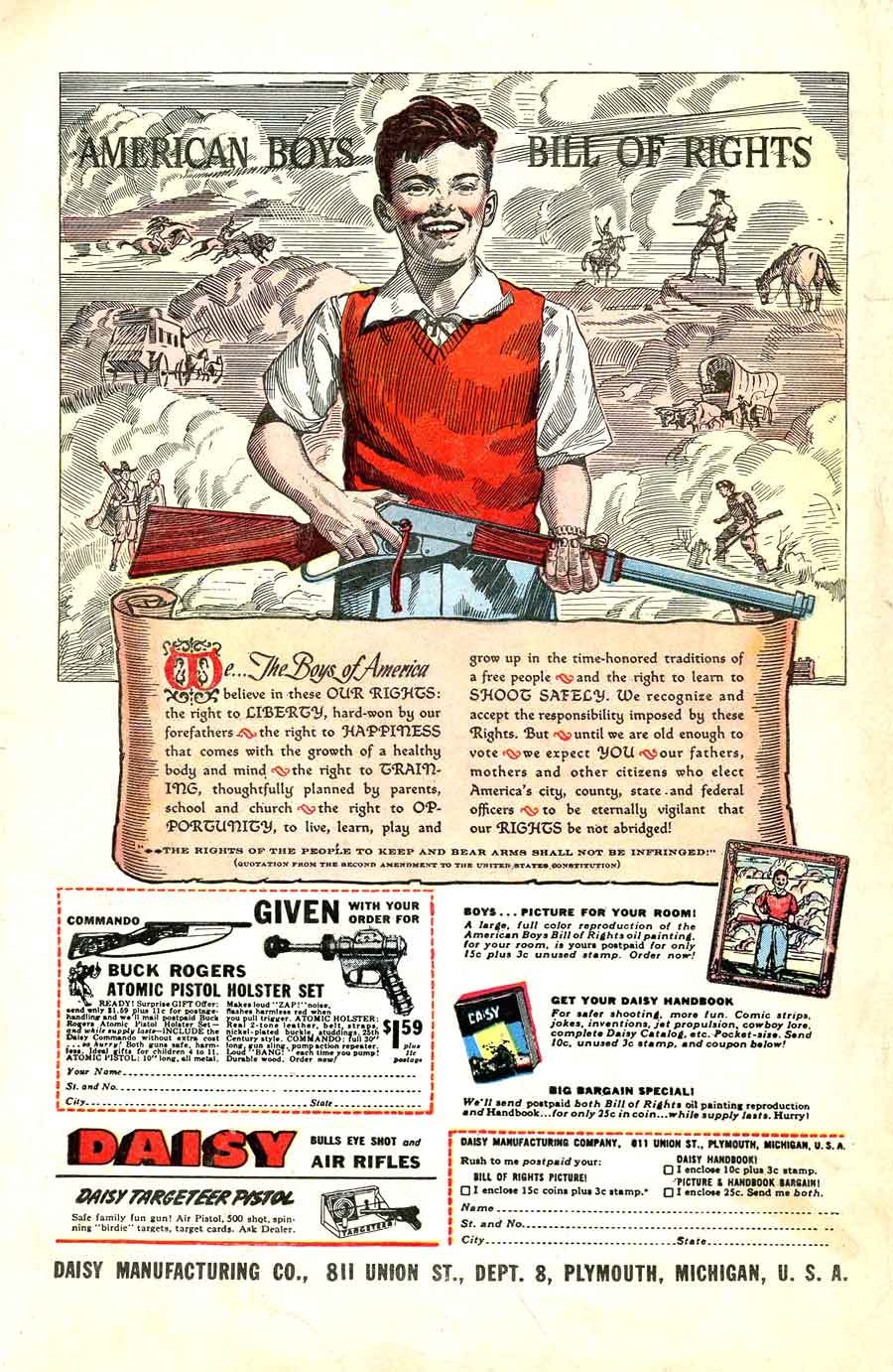
Besides all these "health," bodybuilding, complexion, "bumps-and-bulges," he-man and brutality advertisements there is a stupendous amount of advertising which deserves to be called a childhood armament program. Comic-book advertisements use any device known to advertising writers to fascinate children with weapons. Children have been supplied with arms through these comic-book ads or have learned from them how to make their own weapons, some of them deadly. In one radio discussion about comic books the time-worn argument was raised that Grimm's fairy tales are violent, too. John K.M. McCaffery, newscaster and literary critic, interposed that he had seen lots of weapons advertised in comic books, but had yet to see an edition of Grimm's fairy tales with advertisements of crossbows.
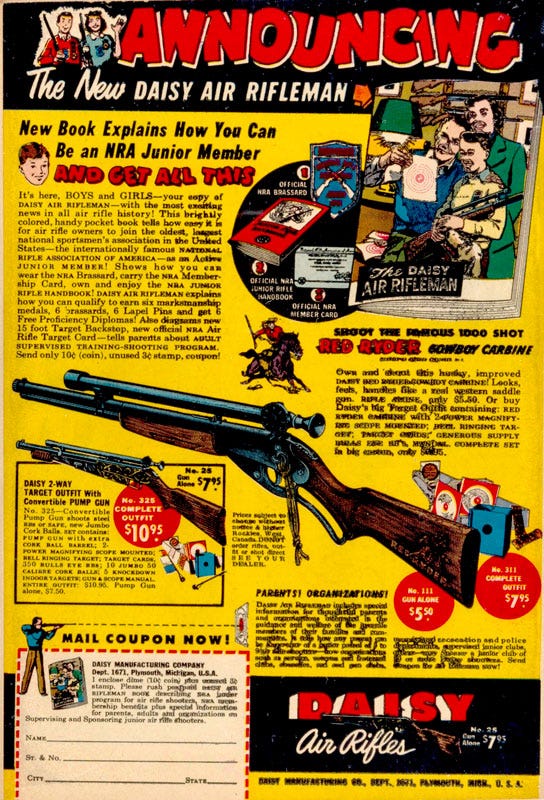
In millions of comic books, ads make all kinds of weapons attractive to children. There are premiums for boys and girls "consisting of genuine .22 cal. rifles" (of course, with an illustration of the rifle). This is a deadly weapon and only the other day a fourteen-year-old boy killed an eighteen-year-old with one of them.
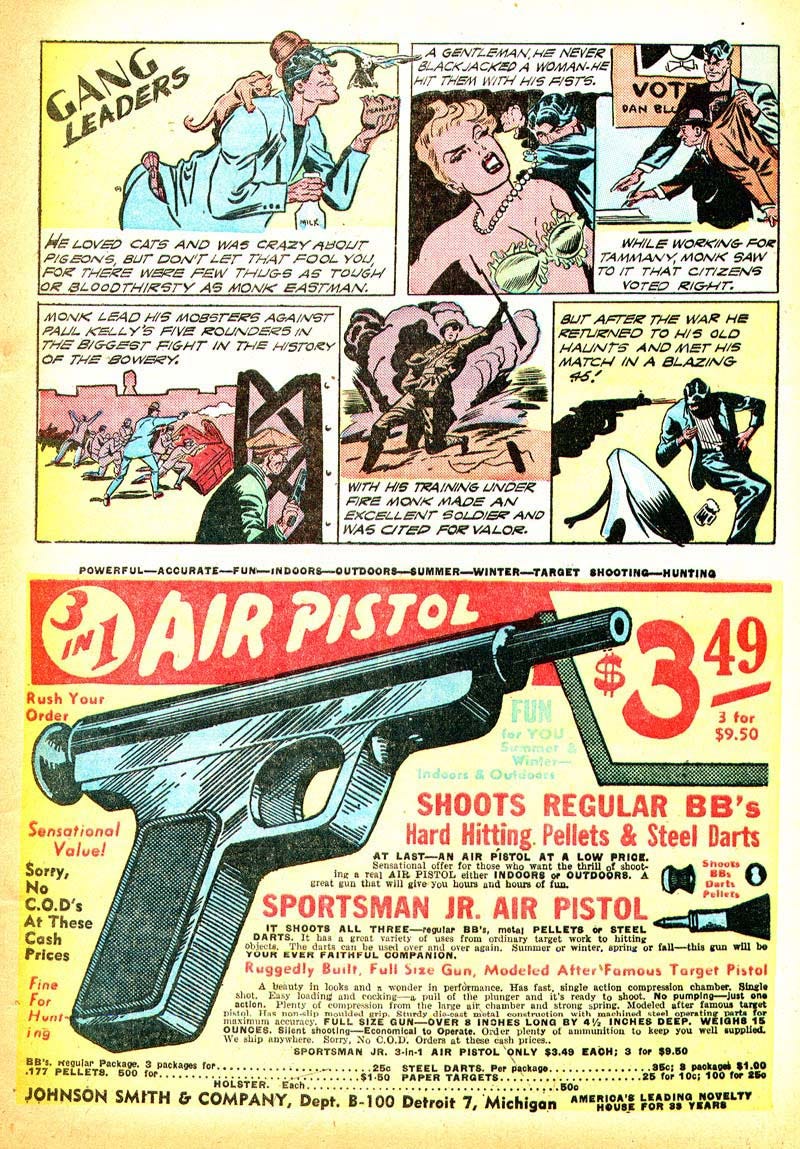
All kinds of "toy" guns and pistols are advertised in comic books. A typical advertisement has a big picture of a gun:
Amazing new gun. Shoots like a real gun.
An accompanying sequence teaches how the gun might be used to threaten people:
You fooled us, kid, I thought that gun was a real one!
Other guns can be transformed into dangerous weapons. An eleven-year-old boy who knew his way around told me about one of them: "They can make it snap faster with an elastic. They shoot little round pebbles. You get the pebbles from puzzles they sell in stores. They fall in little holes when the puzzles are jiggled around."
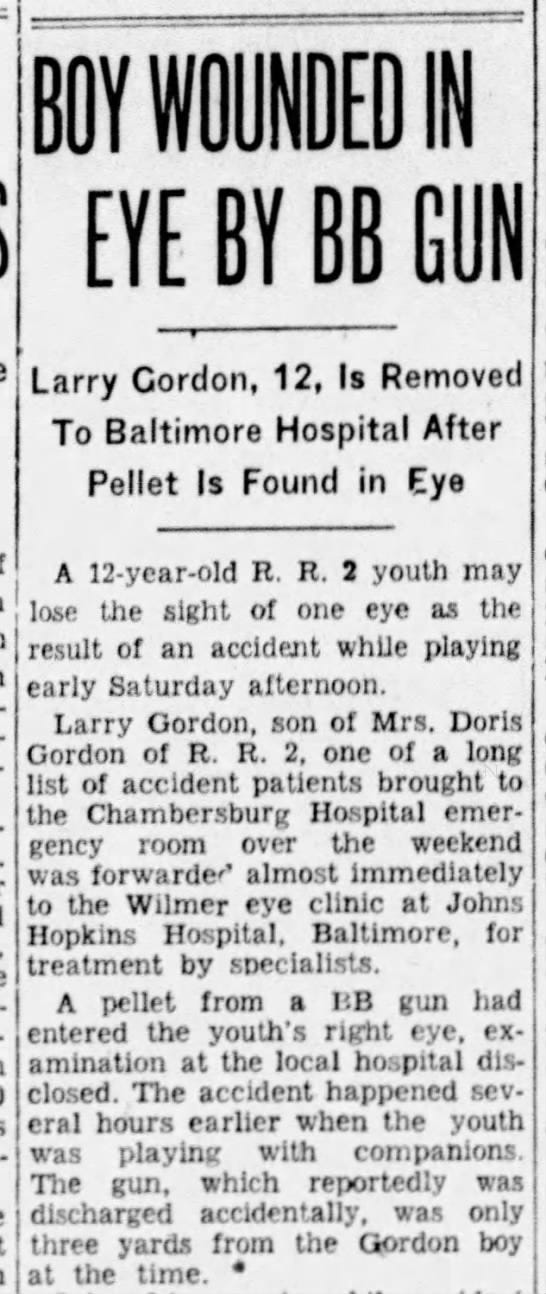
A great role in the advertising is played by B.B. and air guns. Some shoot B.B.'s, some, steel darts. They are considered harmless by some people-but not by children who have been injured or by those who have lost an eye when shot by them.
Medical journals and public agencies have drawn attention to the many serious eye accidents from B.B. and air guns. I inquired of one public agency, which knew of a number of cases blinded by these weapons, what they were going to do about it. They answered that they were "planning a campaign to reach all children in school about the horrors of B.B. guns."
Dr. James B. Bain, of Washington, D.C., reports twenty-nine eye injuries, in five of which an eye had to be removed - all caused by B.B. guns in one single year in Washington alone. As reported in The Journal of the American Medical Association, The Society for the Prevention of Blindness of the District of Columbia reports nine B.B. eye injuries in three months and asks for laws prohibiting the sale of B.B. guns to children under eighteen: "The only effective way of preventing these injuries is to ban the sale, use and possession of air guns."
According to statistics from 421 hospitals all over the country, reported by Pathfinder, there were from Christmas, 1949, through January 1950, 275 air gun injuries; 164 of them were eye injuries, with permanent impairment of vision in sixty-four and eye removal in twenty-five. Philadelphia pioneered with a humane ordinance banning air guns. The results were spectacular, a lesson to those who do not realize that progress in preventive medicine is helped by laws. Where there had been seventeen air rifle eye injuries treated at Wills Hospital in Philadelphia in the short survey period, in the twenty-five months following enactment of the ordinance there was only one.
A similar observation was made in Pittsburgh, where in 1951 an eye injury from B.B. guns occurred once every twelve days; when the use of these guns was restricted there was only one such injury in 1952. No wonder that the National Society for the Prevention of Blindness suggested in 1953 an ordinance, which among other things would prevent the sale of air guns to minors.
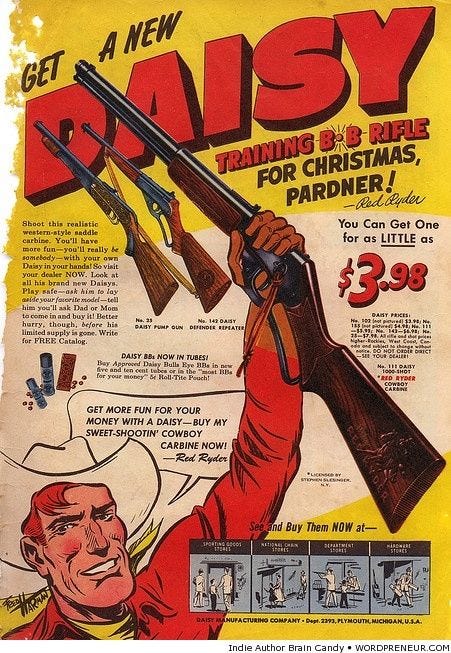
All this is a good illustration of the social problems of comic books. On the one hand adults and children are warned against these guns; at the same time glamorous advertisements in comics seduce more and more children into wanting, buying and using thein. Children's real interests seem to count for little. While the experts in ophthalmology know the danger of these guns and have advocated the only real method of prevention, there are experts in child psychiatry and education who do not draw the line at endorsing comic books which have ads with big pictures of these guns:
Strap this sweet-shootin' [product name deleted] on your bike . . . Only $6.95
Shoot regular steel BBs . . . ($6.95)
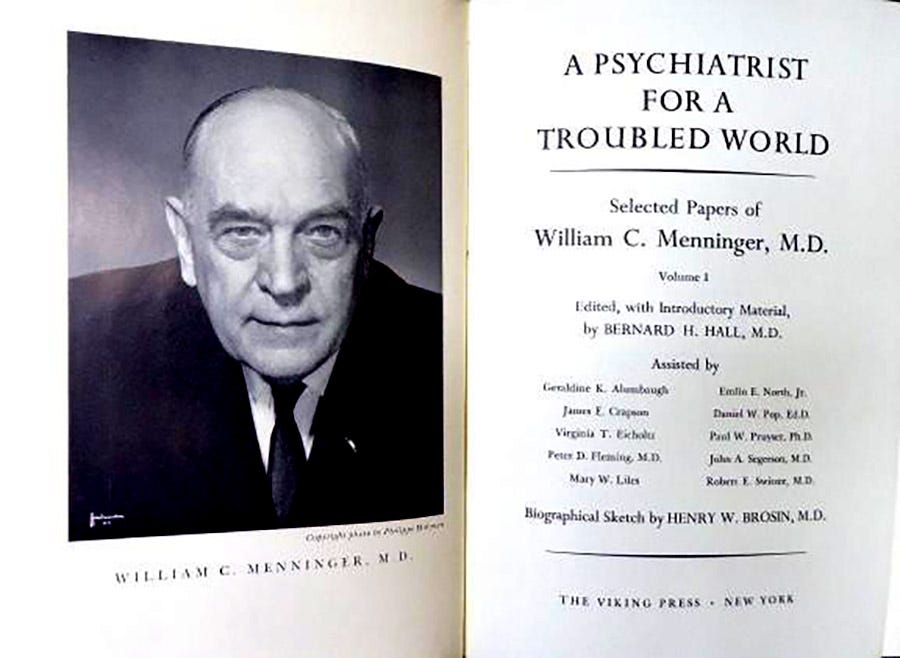
Dr. William C. Menninger has called the pre-adolescent period "the golden age for mental hygiene." It seems also to be the "golden age" for comic-book publishers, advertisers and experts. Text, pictures. and medical endorsements blend to lead both child and parent astray.
Take a 1953 endorsed comic book which contains the story of "Superman when he was Superboy." It has a full-page colored advertisement for an air rifle in which a newspaper editor says about an air rifle program: "The police like the idea - so does the school superintendent - so do the ministers." The ophthalmologists do not!
Shoot regular steel BBs . . . ($6.95)
After one of the instances when a boy was killed in an adolescent gang fight, John E. Cone, chief of the Kings County District Attorney's homicide bureau, made a full investigation which verified my findings on comic-book advertising. He reported:
"We collected a veritable arsenal of home-made weapons, switchblade knives, milk can handles converted into brass knuckles, and so forth. We found out pretty much of their ideas were obtained from comic books. For instance, in one book a lad showed us how to change a converted cap gun into a lethal weapon. And these lads also purchased a number of guns as a result of the advertisements contained in these crime comic books. Many times, they will say that comic books are for adult consumption, whereas actually the advertisements would never appeal to an adult."
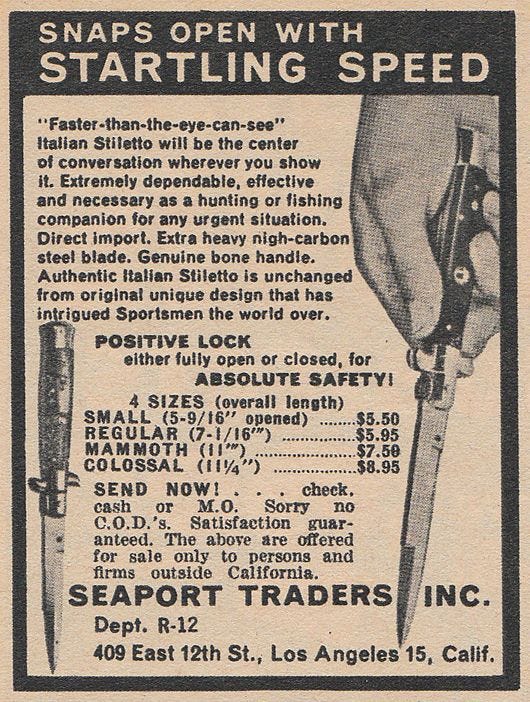
Knives of different kinds are advertised in comic books, too. How far has the armament program for children progressed in the knife category? A search of a single school yielded 141 knives! The attitude of the authorities towards knives in the hands of children seems to be this: Let's permit adults to advertise and sell to juveniles as many knives as possible; then, when they buy and use them let's punish the juveniles as severely as possible. In some neighborhoods detectives and policemen have been instructed to bring to the station house any youth who carries weapons. Weekly checks for dangerous weapons in places where children are apt to meet have been announced. A national magazine had an article about the dangers of switchblade knives sold to and used by children, with the rather cynical comment that the toll up to now was "relatively small - a few dozen children killed, somewhat more wounded."
This article concluded: "Don't let your son be smart-alecky about a knife. De-glamorize knife-carrying to him." What possible good can such suggestions do when at the same time enticing comic-book advertisements offer these very switchblade knives for sale to even the youngest child? And while the ads supply the knives, the stories describe their use for skilled violence. You see the young boy, with his hand in his pocket where the switchblade knife is carried, talking to a grown-up. Suddenly he whips out the knife (and you see the exact way to hold it, with your thumb on the button): "Make a move and I'll whittle you down to half my size!"
Despite the facts that according to police authorities, switchblade knives are "one of the worst weapons out," that their sale to children under sixteen is forbidden, that in New York alone teen-agers and switchblade knives were involved in some one thousand stabbings, that switchblade-wielding teen-agers have been held in bail of $100,000 each, millions of comic books carry illustrated advertisements:
"FLINGS OPEN FAST." "Big size! Only $1.65."
Juvenile gangs sometimes spring up quickly. Gang leaders have told me about the problem of arming them. Here comic book advertising has proved a great help. A full-page advertisement offers a:
10-PIECE KNIFE SET
8-inch blade roast slicer
8-inch blade ham slicer
7-inch blade butcher knife
5-inch blade sandwich knife
4-inch blade utility knife
3-inch blade paring knife
4-inch blade grapefruit knife
8-inch sharpening knife
The question of the kitchen-set knife ads came up several times in Hookey Club sessions. Once a thirteen-year-old boy said, "This knife set in the comic books is disguised as a kitchen set, but of course the kids immediately know what to use them for. They buy them and split them up. In the schools where I was, the boys use them. They have straps and strap them to their legs. See the point there? They specify the point so that you know how you can use it. But they make out it is for meat! Naturally the boys are not going to buy them for cutting meat and so forth!"
One type of advertisement I call the "arsenal ad." It consists of a whole page of illustrations and text offering guns, pistols, rifles, throwing-knives, leather whips, slingshots, fencing-sets and other useful toys for children of the comic book era. Police have found whole arsenals of weapons in children's hiding-places and traced some of the arms back to these ads.